
Anatomy of the golf swing: lag, compression and more
Lag, compression, kinematic sequence, X-factor: the golf swing words nobody explains to beginners, in plain English and with pictures.

This is not a swing lesson
Let me be clear from the start: this article won't teach you how to swing properly. I'm still struggling with it a lot myself.
But when I started, most YouTube tutorials were made by pros or very experienced players, and they talk in a language that nobody bothers to explain. A few months in, I kept hearing about lag and compression. What is it? Why did nobody mention it before? Then came the kinematic sequence, the X-factor, a cupped wrist, early extension. Each one sent me down another rabbit hole.
So this is the glossary I wish I had: what the words mean, what they look like, and, most importantly, how they connect. Because it turns out they are not a list of 20 separate things to think about during a swing. They are one chain.
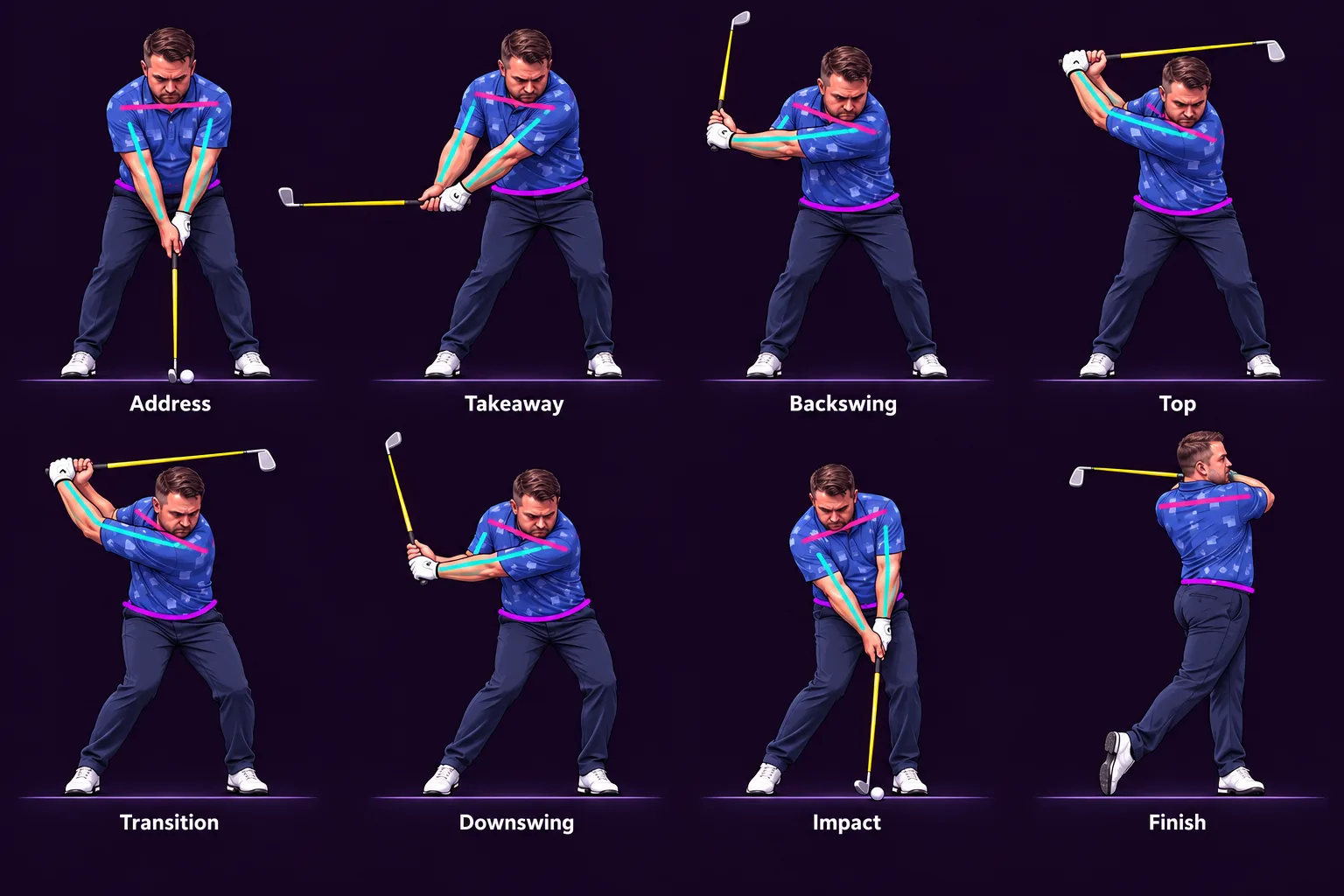
About the pictures: the illustrations use the same color code. Hips are magenta, shoulders and chest are pink, arms are teal, and the club is yellow. Keep that in mind, it will matter in the kinematic sequence section.
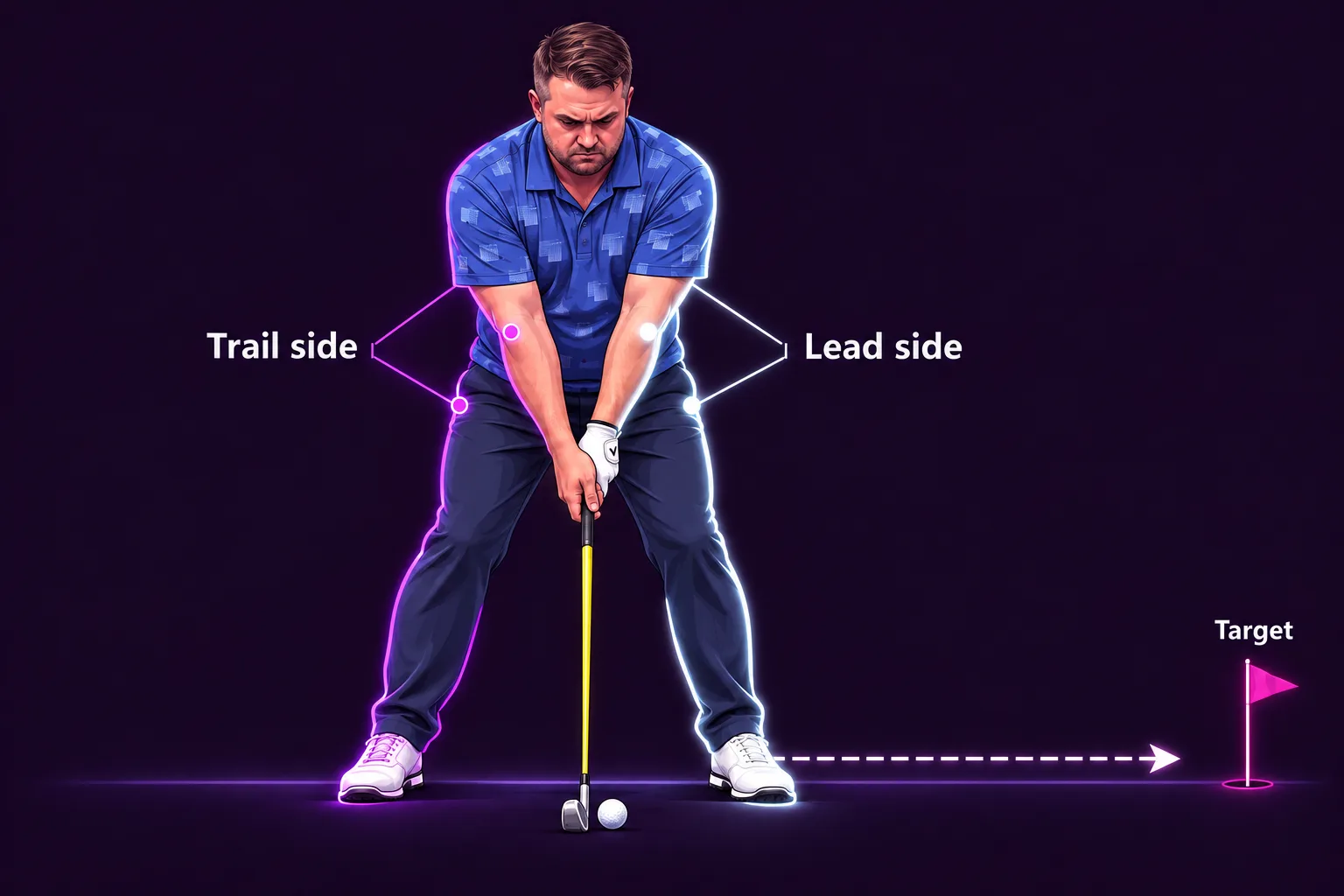
Lead and trail
The first words to learn, because every other explanation uses them:
- Lead side is the side closer to the target. For a right-handed golfer, that's the left arm, left hip, left foot.
- Trail side is the side farther from the target: right arm, right hip, right foot.
Instructors say "lead wrist" instead of "left wrist" so the same tip works for left-handed players too. Once you know that, a lot of tips get easier to follow.
The swing in eight positions
A full swing takes only about a second, but coaches split it into positions so you can talk about each one:
- Address (or setup): standing over the ball, ready to go.
- Takeaway: the first move back, until the club is about hip height.
- Backswing: everything from address to the top.
- Top of the backswing: the body is fully turned and the club is about to change direction.
- Transition: the change of direction. It's the shortest moment in the swing and probably the most important one: this is where the order of movements is decided.
- Downswing: from the top back down to the ball.
- Impact: the moment the club meets the ball. Everything before exists to get this right.
- Follow-through and finish: everything after the ball is gone, ending in a balanced pose facing the target.
Setup: posture, stance and ball position
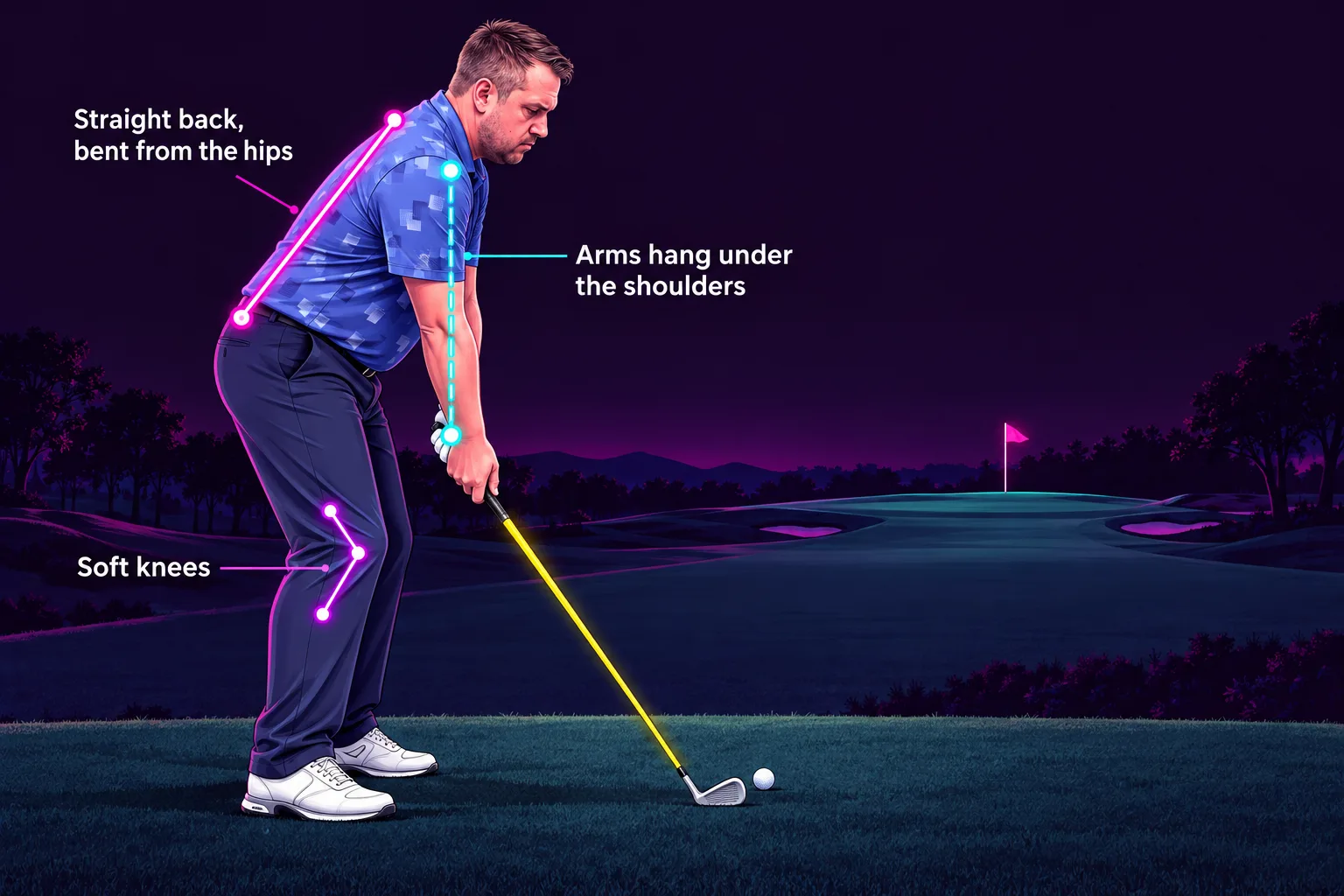
Most swing problems start before the club moves. A few terms you'll hear about the setup:
- Posture: bend forward from the hips with a fairly straight back, flex your knees a little, and let your arms hang naturally under your shoulders. It feels like an athlete's ready position, not like leaning over a table.
- Stance: how wide your feet are. Roughly shoulder width for a mid iron, a bit wider for the driver, a bit narrower for wedges.
- Ball position: where the ball is between your feet. Around the middle for short irons, moving forward (toward the lead foot) as the clubs get longer, up to the inside of the lead heel for the driver.
- Alignment: feet, hips and shoulders parallel to the line from the ball to the target. Picture railroad tracks: the ball is on one rail, your feet on the other.
Weight shift
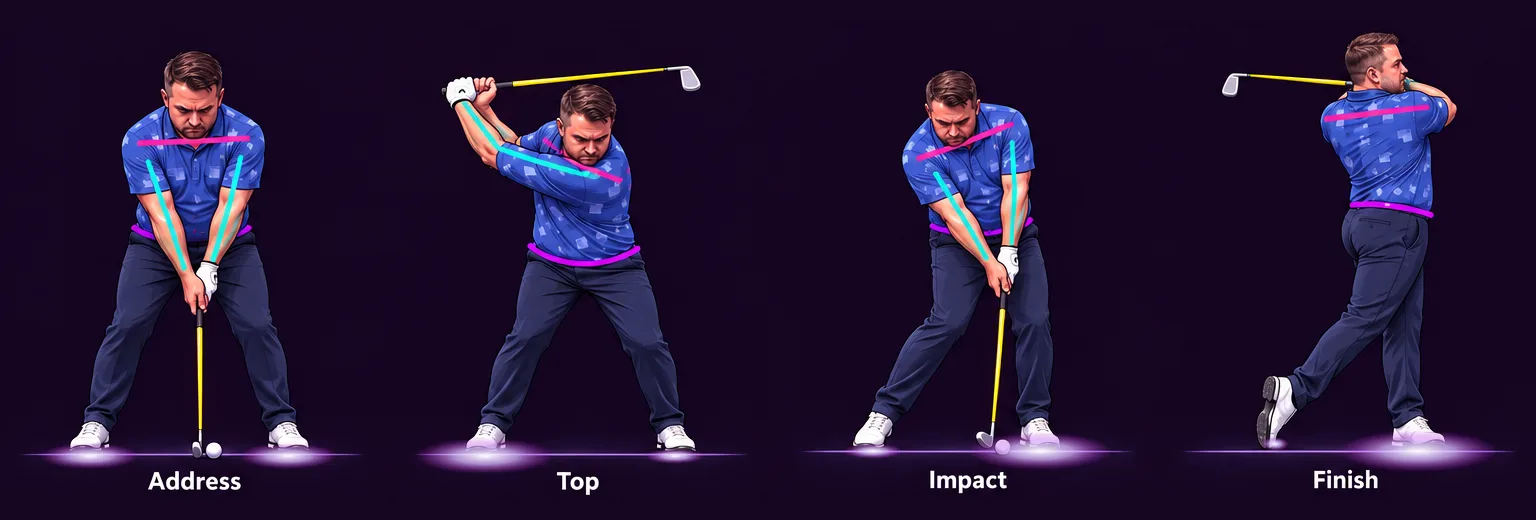
Weight shift is how your weight, or more precisely the pressure under your feet, moves during the swing:
- At address it's roughly even between both feet.
- In the backswing it moves into the trail foot, as your body turns over your trail leg.
- In the downswing it moves to the lead foot, and it starts before the club even finishes going back. The lower body leads the way.
- At the finish almost all of it is on the lead foot, with the trail foot up on its toe.
The classic beginner mistake is the opposite, called a reverse pivot: leaning toward the target in the backswing and falling back in the downswing, usually from trying to lift the ball into the air.
Pivot and the X-factor
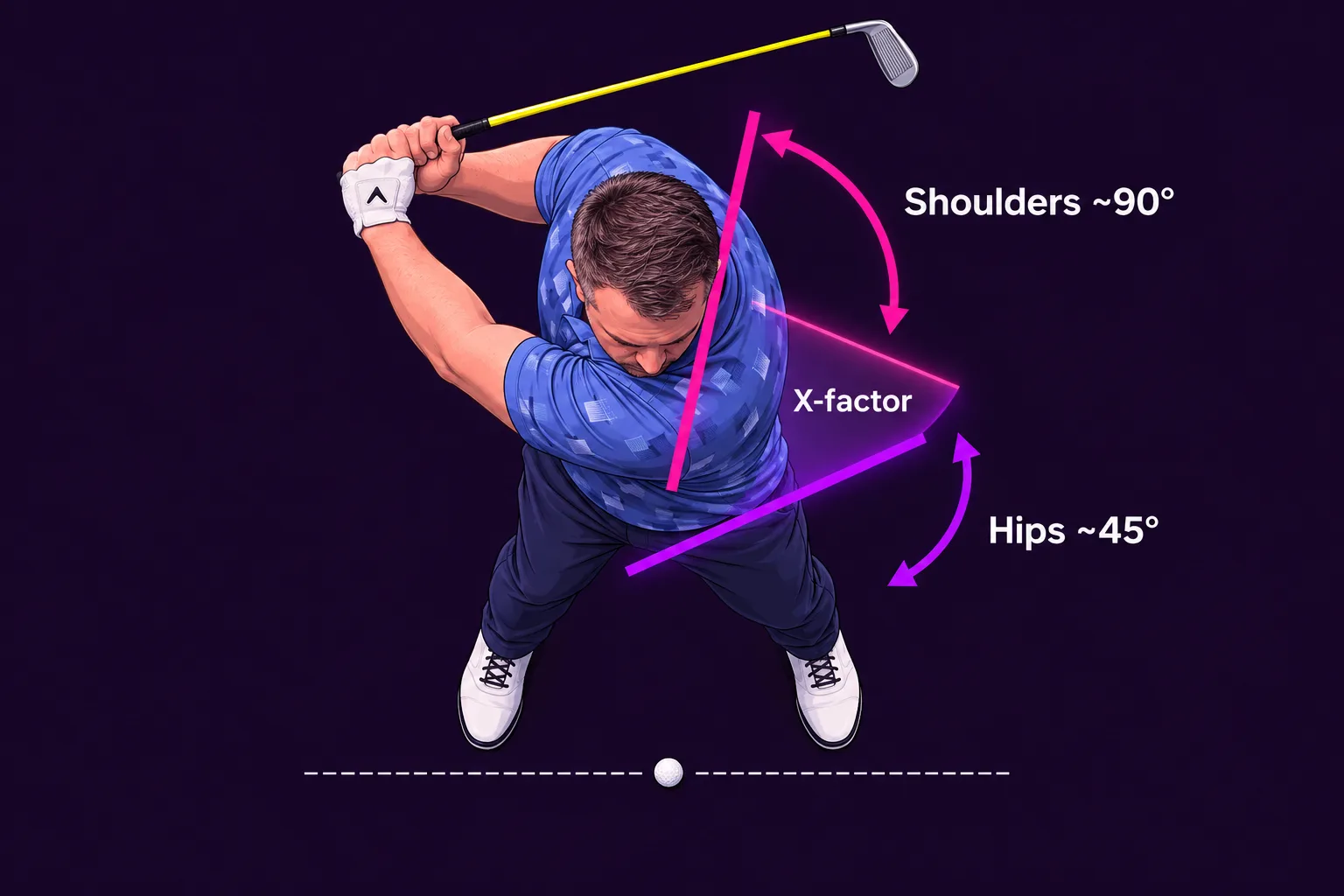
The pivot is the turning of your body: hips and shoulders rotating around your spine in the backswing, then unwinding in the downswing. The key word is rotate. If your hips slide sideways away from the target instead of turning, that's a sway, and it makes solid contact much harder.
In a full swing, the shoulders turn roughly 90 degrees and the hips roughly 45 degrees. The difference between the two is called the X-factor, a term popularized by coach Jim McLean in the 1990s. The idea: the more your shoulders turn against hips that resist, the more the body is coiled like a spring, and the more speed it can release. That doesn't mean you should force a huge turn: how far you can turn depends on your flexibility.
Wrists: hinge, cupped and bowed
Wrist hinge (also called wrist cock) is the wrists bending upward, thumbs toward you, as the club goes back. By the top of the backswing it creates roughly a right angle between your lead arm and the shaft. Remember that angle, it's the star of the lag section.
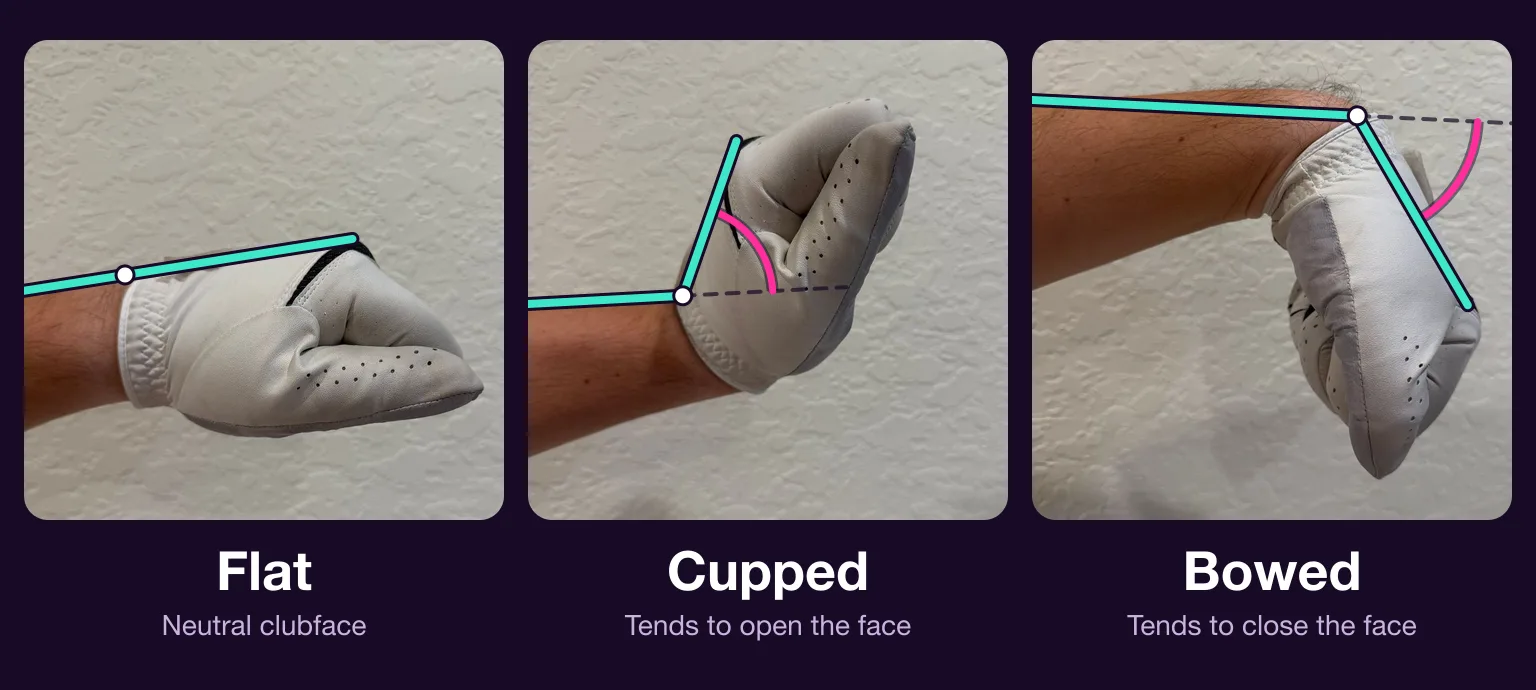
The other thing you'll hear about is the shape of the lead wrist at the top:
- Flat: the back of the lead hand is in line with the forearm. The textbook neutral position.
- Cupped: the wrist is bent back. It tends to open the clubface, a common cause of slices.
- Bowed: the wrist is bent forward. It tends to close the clubface. Some great players, like Dustin Johnson, swing with a strongly bowed wrist at the top.
None of these is "wrong" on its own. What matters is that the rest of the swing matches it. But if your ball keeps curving right, a cupped lead wrist is one of the first things a coach will check.
Kinematic sequence
This is the big one. The kinematic sequence is the order in which the body parts speed up in the downswing. Researchers who measured huge numbers of swings with 3D motion capture (most famously the Titleist Performance Institute) found that good players follow the same order:
- Pelvis
- Chest
- Arms
- Club
Each segment speeds up, reaches its peak speed, then slows down, and that slowdown passes the energy on to the next segment, which ends up faster. Think of cracking a whip: the handle moves a little, the tip breaks the sound barrier. Your hips are the handle, the club head is the tip.
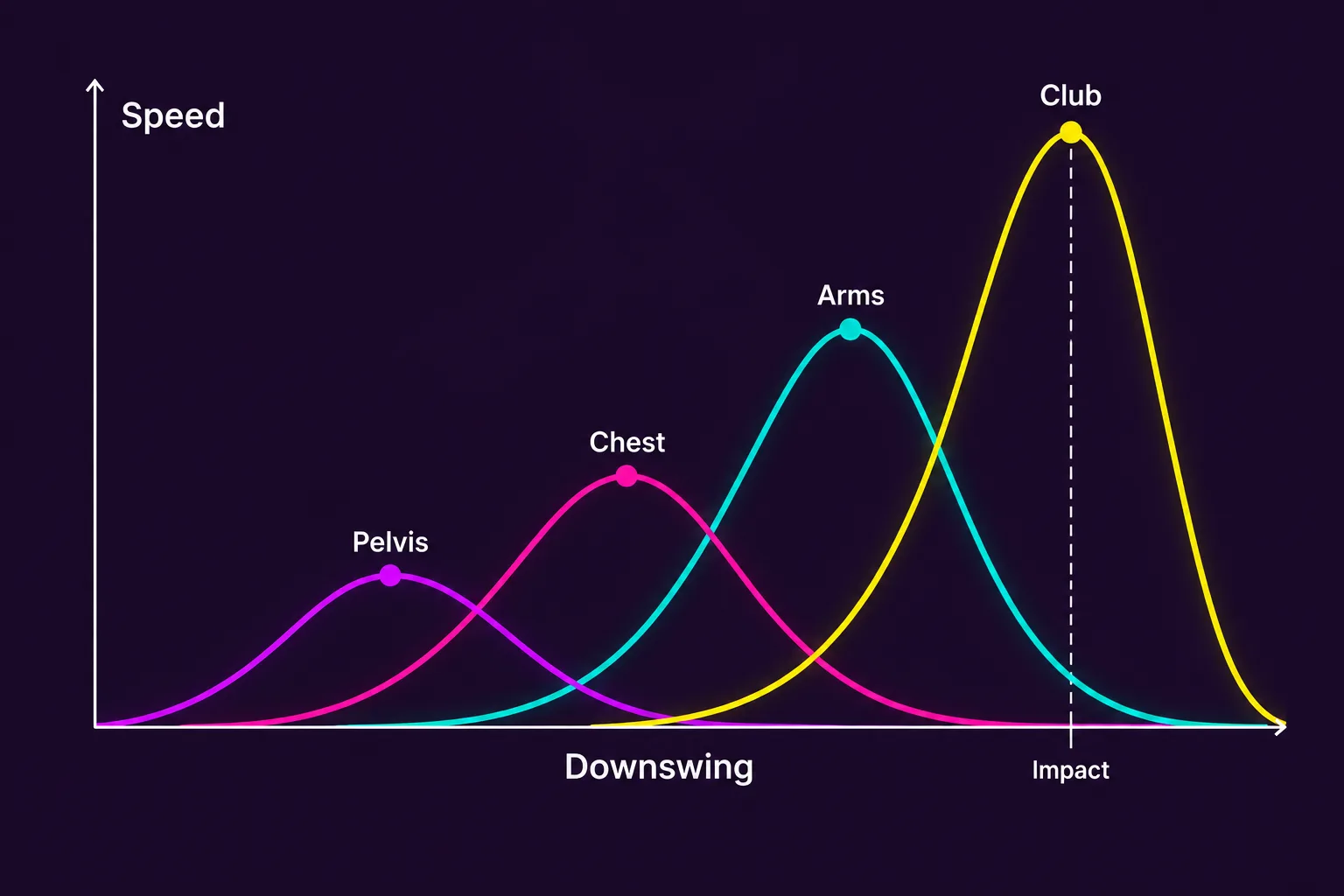
The natural instinct, especially for a beginner, is to hit the ball with the arms and shoulders, starting from the top. That flips the sequence: the arms fire first, the hips have nothing left to add, and the club arrives slow, usually from outside the line. That's the famous over the top move, and the reason so many beginners slice.
Lag
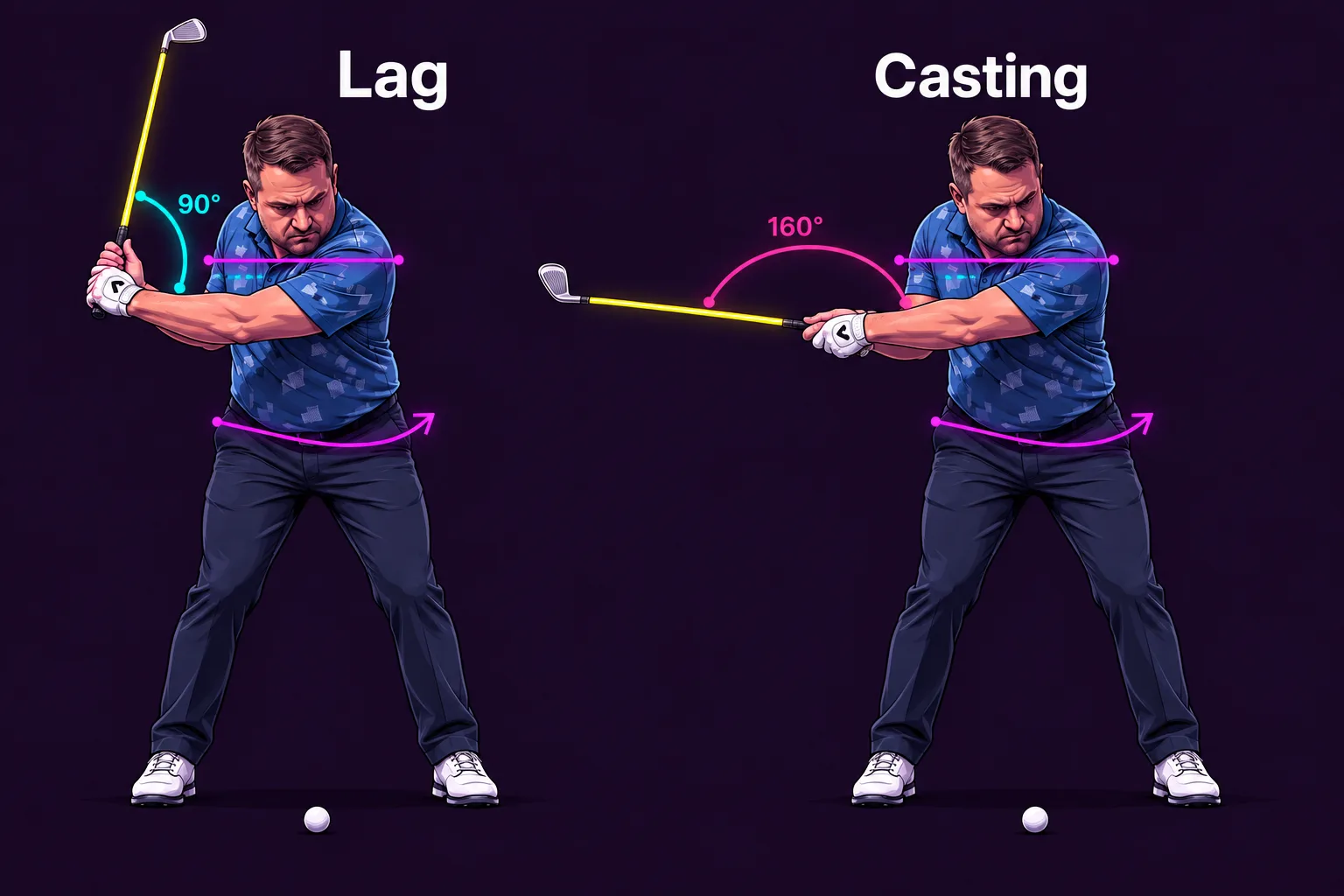
Lag is keeping that wrist hinge, the angle between the lead arm and the shaft, well into the downswing, so the club head trails behind the hands. In the downswing, when your lead arm is parallel to the ground, a player with good lag still has the shaft pointing almost straight up.
The opposite is casting: unhinging the wrists right from the top, like casting a fishing rod. The angle is spent early, the club head reaches top speed before the ball instead of at it, and the shot is weak.
Here is the part nobody told me: you don't create lag by holding the angle. It's mostly a result. When the pelvis starts the downswing and the arms and club are still finishing the backswing, the club gets left behind automatically. Lag is what a good kinematic sequence looks like from the outside. Trying to hold it with your wrists usually just makes things tense.
Release
The release is where the stored angle is finally let go: the wrists unhinge and the forearms rotate through impact, squaring the clubface and whipping the club head past the hands just after the ball. A good release happens late and on its own, as the body keeps turning.
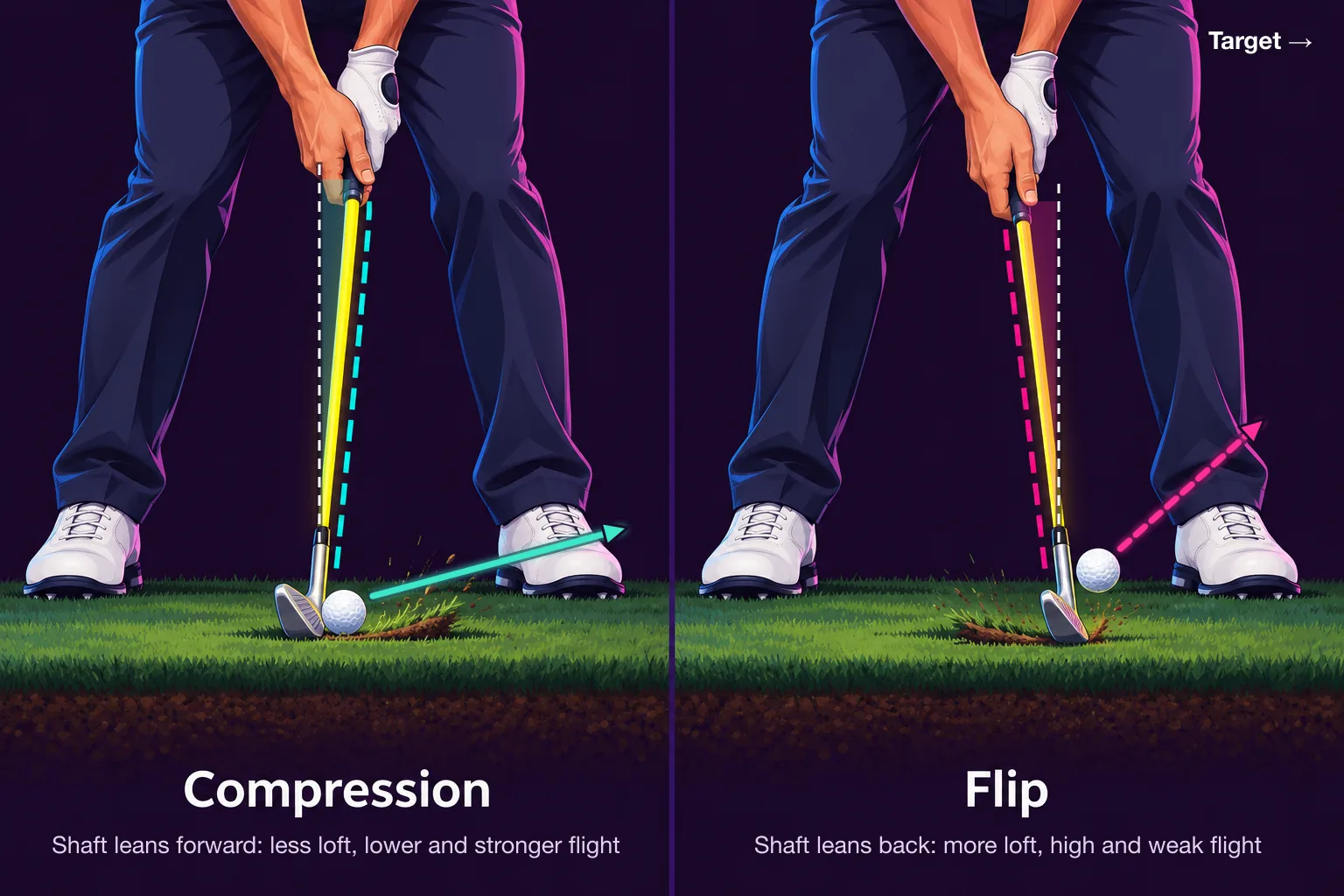
A bad release has its own name, the flip (or scoop): the wrists break down before impact, the club head passes the hands too early, and you try to help the ball into the air. Which brings us to...
Compression
Compression is the word for that solid, heavy "thump" of a well-struck iron shot, the feeling of trapping the ball between the clubface and the ground. Technically it comes down to what happens at impact:
- The hands are ahead of the ball, roughly over the lead thigh.
- The shaft leans toward the target, called forward shaft lean.
- The club hits the ball first, then the ground.
Forward shaft lean also takes some loft off the club. Your 7 iron has its loft stamped on it, but what matters is the dynamic loft, the loft at the moment of impact, and a good player delivers it with several degrees less. The ball comes out on a lower, more penetrating flight and flies farther and more consistently. (Clubmakers have been strengthening iron lofts for decades for the same reason.)
The flip is the exact opposite: hands behind the ball, shaft leaning back, extra loft, a weak, high, short shot or a thin one. And it comes from the most natural thought in golf: "I need to get this ball up."
Low point
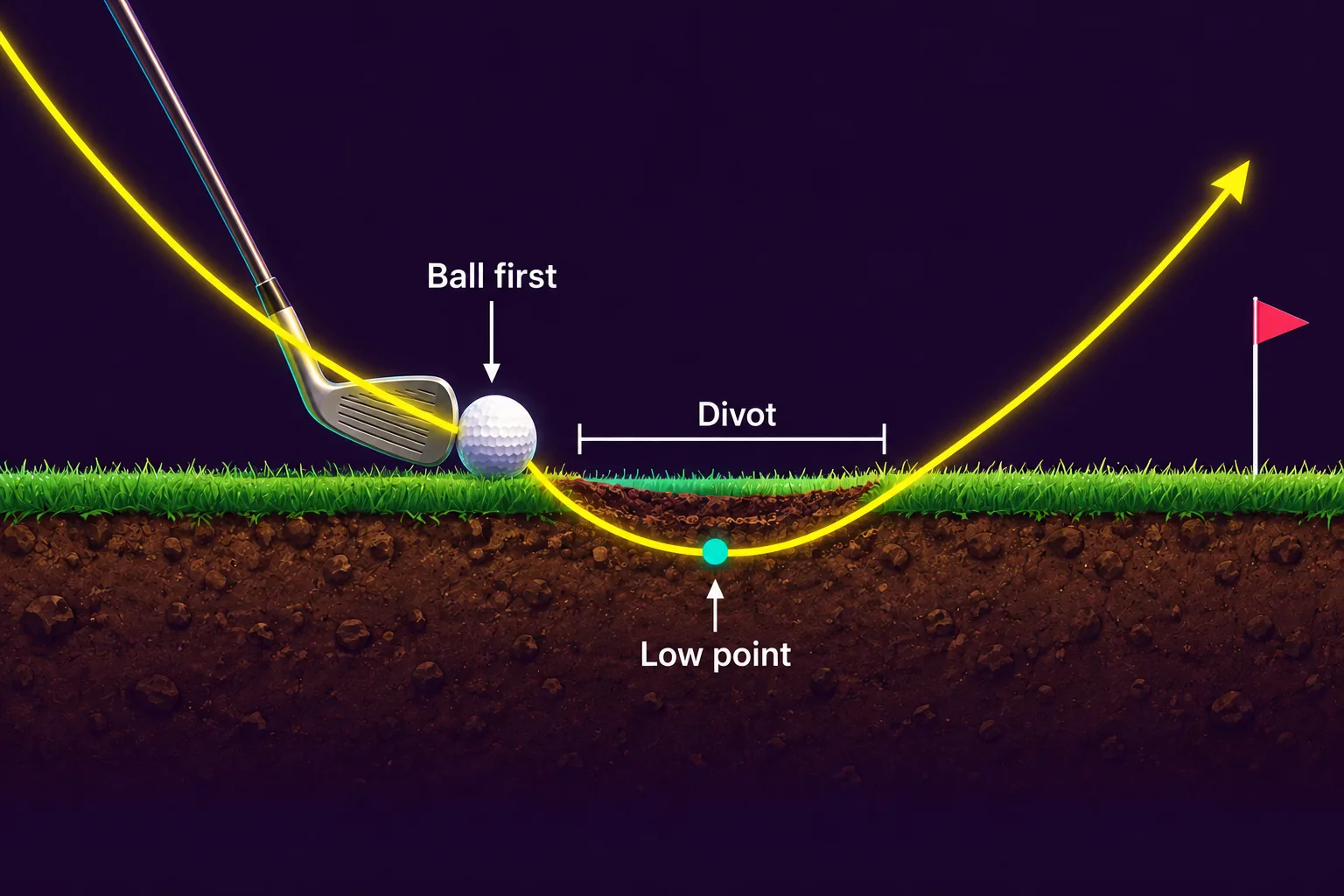
The low point is the bottom of the arc the club head travels on. With irons, it should be a few inches after the ball, on the target side. That means the club is still moving down when it hits the ball, the ball is struck first, and the divot starts at or just after where the ball was.
This explains the biggest paradox in golf: to hit the ball up, you hit down on it. The loft of the club gets the ball in the air, not your swing.
If the low point is behind the ball, you hit the ground first, a fat shot (or chunk), or the club bottoms out early and catches the ball on the way up, a thin shot. I hit plenty of chunks, and now at least I know why.
The driver is the exception: the ball sits up on a tee, forward in the stance, and many players hit slightly up on it.
How it all connects
Here is the chain, the one thing I'd want a beginner to take from this article:
- A good setup and pivot let the body turn and load the trail side.
- In the transition, the weight shifts to the lead side and the pelvis starts the downswing first.
- The body unwinds in the right kinematic sequence: pelvis, chest, arms, club.
- Because the body leads, the club is left behind: that's lag.
- The stored angle releases late, through the ball.
- The hands arrive ahead of the club head: compression, with the low point after the ball.
Lag and compression are not two more things to think about. They're what you get when the parts move in the right order. Understanding the chain is the easy part. Actually doing it is what I'm still struggling with.
Quick glossary
A few more terms you'll hear on the range and in videos:
- Over the top: starting the downswing with the shoulders and arms, so the club comes down outside the ideal path. Leads to slices and pulls.
- Early extension: the hips moving toward the ball in the downswing, standing up out of your posture. A common cause of shanks and blocks.
- Chicken wing: the lead elbow bending and pulling away after impact instead of extending toward the target.
- Shallowing: the shaft flattening out early in the downswing so the club approaches the ball from the inside. The cure many coaches give for over the top.
- Steep: the opposite of shallow. The club comes down at a sharp angle, digging deep divots.
- Swing plane: the tilted surface the club travels on during the swing. "On plane" means it stays on it.
- Club path: the direction the club head moves through impact: in-to-out, out-to-in or straight.
- Face angle: where the clubface points at impact. Together with the path, it decides where the ball starts and how it curves.
- Slice / fade (for right-handers): a ball curving right. A fade is a gentle, controlled one; a slice is the big banana that ends up in the neighbor's pool.
- Hook / draw: the same to the left. A draw is the gentle, controlled version; a hook is the one that dives into trouble.
- Shank: the ball hits the hosel, where the shaft meets the head, and shoots off almost sideways. The scariest word in golf; some players won't even say it.
- Smash factor: ball speed divided by club speed, a measure of how centered the strike was. Around 1.5 is about the maximum with a driver.
If you want to watch me struggle with every single one of these on camera, the episodes are on YouTube. And if you're new here, start with what golf actually is.