
What is golf? A short history from Scotland to Topgolf
I used to think golf was the most boring way to waste time. Then I tried it. Here is what the game is, where it came from and how its rules changed.
What I thought golf was
Driving past golf courses, I used to look at the guys walking around a field, rolling balls with their sticks, and think: this is the most boring activity ever. I value my time a lot, so golf looked like a very expensive way to waste it.
Then a few months ago I went to Topgolf with my kid, just to check it out. I'm not sure what happened, but something clicked the first time I picked up a club and tried to hit that little white round sucker. After a one-hour session I wasn't obsessed yet, but I was extremely interested. I wanted to hit that ball right. I wanted it to fly far and high.
The next thing I did was buy my first ever club, a 7 iron (Claude AI picked it for me). I practiced a little at home, went back to Topgolf a couple of times, now with my very own club, and realized I enjoy the process a lot. It's challenging and it's thoughtful. You spend most of the time figuring out what you are doing wrong and what to do better to hit that little white round sucker.
A few weeks later I thought, why not, and went to play a real round at the local public course. Calling it a "round" is generous: my longest shot was probably a few yards. But I was blown away by the whole thing: the rules, the obstacles, the walking. It turned out to be a real physical and endurance challenge. By hole five I was more exhausted than I can remember ever being, and I just couldn't go on. And I was so happy. After dozens of misses and chunks, I hit that little white sucker properly maybe a couple of times, and that was enough. It kept me motivated, and it still does. Golf is now one of my favorite things to do in the world.
What I think golf is now
A few months of playing and practicing later, here is how I see it:
- It's physically hard. You may not think so, but walking or riding a cart for three or four hours in the heat and swinging hard takes a lot of energy. Which also makes it great for your health.
- It's a game of the mind. You think about strategy all the time. Go for it and try to hit it farther, or play it safe and shorter? Bunkers, rough, water, fairways, greens, and the neighbors' houses and pools. So many situations.
- It's you against the course. There are few games where you have no teammates and no opponent standing in your way. It's you versus yourself and versus the field, and almost everything depends on you.
- There is no max level. Nobody plays every hole in par or birdie. Even pros with 50 years of experience still make mistakes. That's the best part: it keeps you improving, keeps you thinking and keeps you in shape.
Meanwhile I got curious about the history. Where and when was golf born? What were the original rules, and what are they now? I was sure it was a century-old game at most. It turned out to be much older than that. So here is what I found out. If you've never tried golf and, like me, think it's the most boring and time-wasting thing in the world, maybe by the end you'll want to give it a go.
Golf in one paragraph
You hit a ball from a starting area (the tee) into a hole about 4¼ inches wide, somewhere between 100 and 600 yards away, in as few strokes as possible. Do that 18 times and add up the strokes. Each hole has a par, the number of strokes a good player should need, usually 3, 4 or 5. Lowest total wins. Everything else, the 14 clubs, the bunkers, the rule book, the dress codes, is built on top of that one idea.
Born on Scottish sheep pastures
People have hit things with sticks forever. The Romans had a game with a bent stick and a stuffed leather ball, China had chuiwan about a thousand years ago, and in the Middle Ages the Dutch played colf, hitting a ball at a target like a door or a post. That word is probably where "golf" comes from.
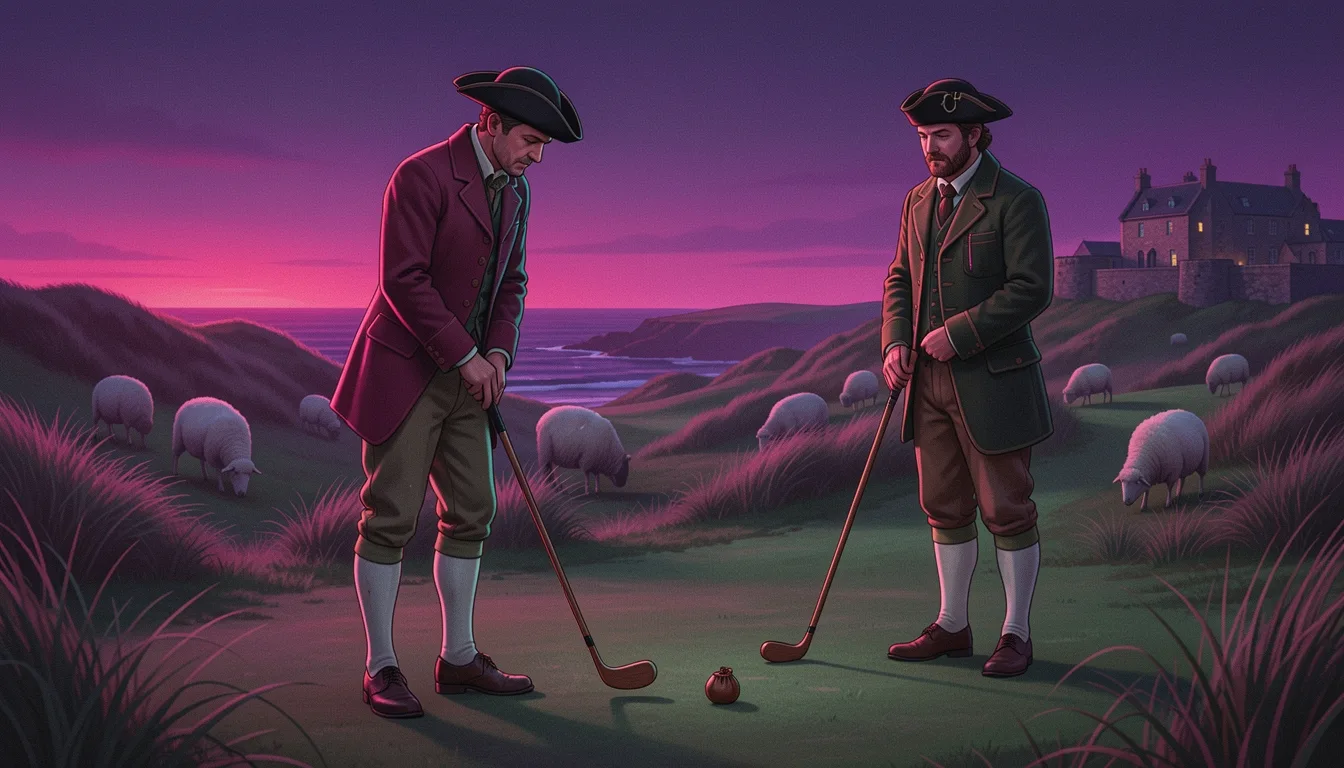
But the game we play now, hitting a ball across open country into a hole in the ground, comes from the east coast of Scotland in the 1400s. It was played on the links: the sandy strip of land between the sea and the farmland. Nothing grew there except tough grass, so it was good only for grazing sheep. The sheep kept the grass short, and they huddled in hollows out of the wind, which wore those hollows into sandy pits. Those are, very likely, the first bunkers.
That is why the oldest courses, like the Old Course at St Andrews, are still called links, and why "links golf" today means windy, treeless seaside courses with bouncy ground.
Banned by the king
The first time golf shows up in writing, it's being banned. In 1457, the Scottish Parliament under King James II declared that "fute-ball and golf be utterly cryit doune". Scotland was regularly at war with England, and men were spending their Sundays playing golf instead of practicing archery.
The ban was repeated in 1471 and 1491 and mostly ignored. Then in 1502, King James IV signed a peace treaty with England, the archery problem went away, and the king himself started playing. The royal accounts show him buying clubs and balls from a bowmaker in Perth that year. Golf has been a game of kings ever since. Mary, Queen of Scots, was reportedly criticized in 1567 for playing golf days after her husband was murdered.
So when I thought golf was a century old, I was off by more than 450 years.
The first rules: 13 of them
For 300 years golf had no written rules, just local customs. That changed in 1744, when a group in Edinburgh called the Gentlemen Golfers of Leith organized a competition for a silver club donated by the city. To run a competition you need rules, so they wrote down 13 Articles. Golf's whole rule book started on one page.
Some of them, with the spelling tidied up:
- Rule 1: "You must tee your ball within a club's length of the hole." There were no separate tee boxes. You teed off for the next hole right next to the one you just finished.
- Rule 3: "You are not to change the ball which you strike off the tee." Still true today: you play one ball from tee to hole.
- Rule 5: If your ball goes into water "or any watery filth", you may take it out, tee it up behind the hazard and play on, giving your opponent a stroke. That's a one-stroke penalty for water, same as now.
- Rule 8: If you lose your ball, go back to where you last hit from, drop another ball and take a one-stroke penalty. That's the modern "stroke and distance" rule, almost word for word.
- Rule 10: If your ball is stopped "by any person, horse, dog, or anything else", you play it where it lies.
- Rule 12: "He whose ball lies farthest from the hole is obliged to play first." Still the basic order of play.
What strikes me is how much has survived. Play the ball as it lies, one stroke for water, stroke and distance for a lost ball, farthest from the hole goes first: all of it was there in 1744.
Ten years later, in 1754, golfers at St Andrews formed their own society and adopted almost the same rules. That club later became the Royal and Ancient Golf Club of St Andrews, and its rules committee (today simply The R&A) ended up writing the rules for most of the golfing world.
Why 18 holes
Early courses had however many holes fit the land. Leith had five. Prestwick, where the first Open Championship was played in 1860, had 12. St Andrews had 22: eleven holes out along the shore and the same eleven back.
In 1764, St Andrews merged its first four short holes into two. Out and back, that turned 22 holes into 18. Other clubs gradually copied the most famous course in the world, and by the late 1800s a round of golf meant 18 holes.
The popular story that 18 holes is how long a bottle of whisky lasts, at one shot per hole, is a fun one, but it's a myth. So is the idea that GOLF stands for "Gentlemen Only, Ladies Forbidden". The word is older than English acronyms and comes from the Scots gouf or gowf.
The ball changed everything
If you want to understand how golf evolved, follow the ball.

| Years | Ball | Made of | What it changed |
|---|---|---|---|
| 1600s–1840s | Featherie | Wet leather stuffed with a top hat's worth of boiled goose feathers | Expensive, handmade, a few per day. Useless when wet. Golf stayed a rich man's game |
| 1848 | Gutty | Molded gutta-percha, a rubbery tree sap | Cheap and tough. Golf opened up to many more people |
| 1898 | Haskell | Rubber thread wound around a core, with a cover | Flew much farther. Courses had to get longer |
| 1900s–now | Dimpled | Multi-layer rubber and plastic, around 300–400 dimples | Today's ball, with size and weight fixed by the rules |
The best story is the dimples. New gutty balls were smooth, and golfers noticed that old, beaten-up gutties flew better than new ones. The nicks and scratches helped the ball hold its flight in the air. So ball makers started hammering patterns into new balls on purpose, and eventually that turned into the dimples every ball has now.
The ball also decided what clubs looked like. A soft featherie would split if you hit it with iron, so for a long time almost every club was wooden, and irons were only for getting out of ruts and bad lies. Once the tough gutty arrived, irons took over. That story got its own article.
Rules that changed since
The R&A in Scotland and the USGA (founded in 1894) in the United States wrote the rules separately for a while. Since 1952 they have published one shared rule book. A few milestones:
| Year | Change |
|---|---|
| 1891 | The hole is fixed at 4¼ inches (108 mm), the size of a hole cutter used at Musselburgh since 1829 |
| 1938 | A 14-club limit (adopted by the R&A in 1939). Before that some players carried 20 or more |
| 1952 | The stymie is abolished. Until then, if your opponent's ball blocked your path on the green, you had to putt around it or chip over it |
| 2019 | The biggest cleanup in decades (today's rules): you can putt with the flag in, drop from knee height, search for a lost ball for 3 minutes instead of 5, and repair spike marks on the green |
| 2020 | The World Handicap System: one handicap that works everywhere, so a beginner can play a fair match against a scratch golfer |
The 2019 changes are the ones I'm grateful for as a beginner. They made the game faster and less of a lawyer's exam, and three minutes is plenty of time to look for a ball I sliced into a neighbor's pool.
Golf today
Golf went from Scottish sheep pastures to everywhere. It was in the Olympics in 1900 and 1904, then disappeared for 112 years and came back in 2016. In 1971, Apollo 14 astronaut Alan Shepard hit two golf balls on the Moon with a 6-iron head attached to a tool handle.
And now there is Topgolf, simulators and driving ranges with music and food, where lots of people hit their first ball without setting foot on a course. That's where I started. A game that was banned for distracting men from archery practice is now distracting me from pretty much everything.
If you've never tried it, go hit a bucket of balls. Worst case, you've wasted an hour. Best case, you'll be like me, writing articles about the 1744 rules at midnight.